Fundamentals of wood as a material
First of all, wood must be understood as an anisotropic material. Anisotropy describes the dependence of the wood properties on its main grown anatomical directions, which are defined starting from the fibre direction. Before we go into these directions in more detail, the basics of the tree are explained.
The growth
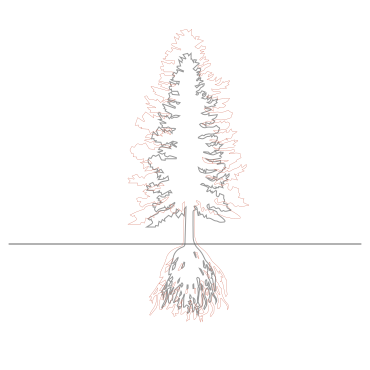
The tree grows in height at the root and branch tips, its thickness growth occurs through the expansion of the trunk circumference. Growth can be attributed to cell division, elongation and differentiation (cf. Andre' Wagenführ, 2018, p. 13). Like all plants, the tree grows through photosynthesis. This process describes a physiological process by converting light energy (sun) with the help of light-absorbing pigments (chlorophyll) into chemical energy, which is then used for growth. In our latitudes, the tree grows mainly from spring to late summer. In the winter months, however, it grows much less.
The zones

The main feature of the wood, the annual rings, are made up of earlywood and latewood. The early wood grows faster and thus forms softer larger cells. The latewood, on the other hand, grows slowly and the cell structure is narrower and firmer.
The pith lies within the first annual ring and serves the tree as a water conduit from the roots into the branches.
The supporting function in the trunk is taken over by the heartwood, which is located between the pith, running radially to the sapwood. This part is also called useful wood.
After the heartwood is the sapwood, which is clearly lighter in colour. The sapwood conducts nutrients from the roots to the crown of the tree. The sapwood is less durable than the heartwood.
The cambium forms a thin ring layer after the sapwood. This layer is responsible for length and thickness growth and forms new wood cells towards the trunk axis and bast cells towards the bark.

The protective layer of every tree is the bark, which is composed of bast and bark. This layer protects the tree from drying out, UV rays and mechanical damage (Wolfram Scheiding, 2015, p. 23). The described growth and zones of the tree illustrate the special nature of the anisotropic material wood. Wood has its own system and requires knowledge about the directions in which it can be used. Steel and concrete, on the other hand, are homogeneous materials that act in the same way in every direction. Furthermore, each tree species also shows differences such as colour, hardness, speed of growth and longevity (cf. Andre' Wagenführ, 2018, p. 22).
View from fibre direction
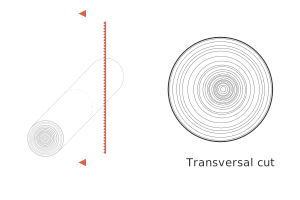
When the trunk is cut across the grain, we can most clearly see the individual zones of the tree.
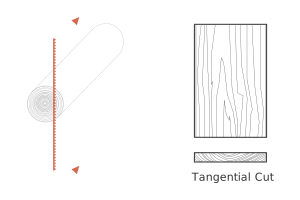
Cut tangentially, i.e. parallel to the trunk axis, the cut shows fladering and horizontal annual rings.
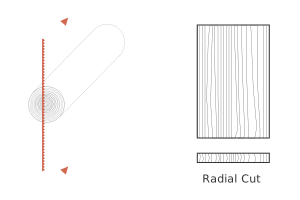
If the trunk is cut radially, i.e. through the central axis, we see the standing annual rings.
Dimensional changes
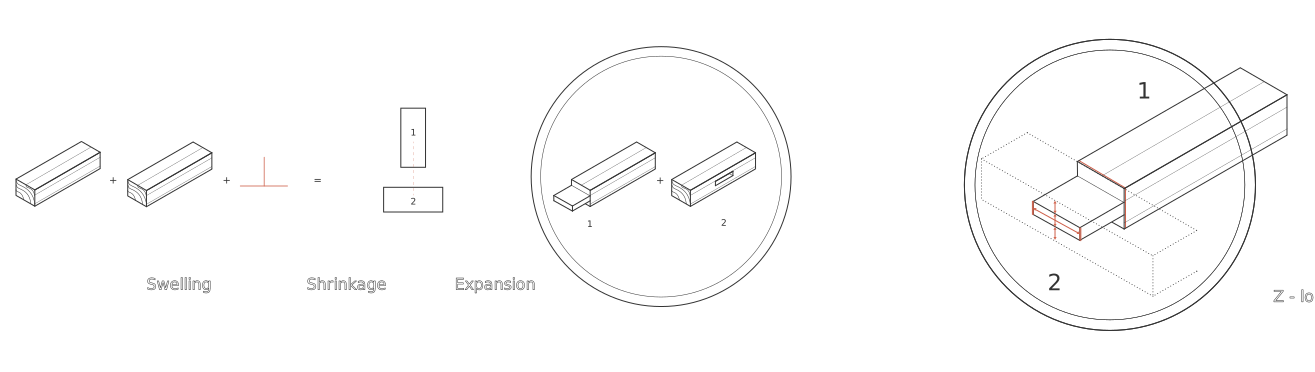
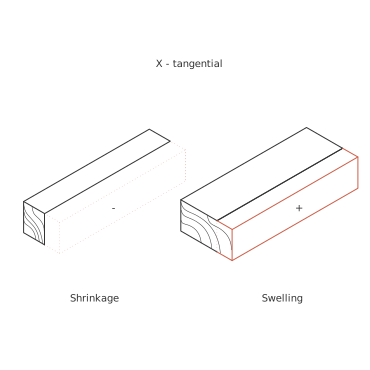
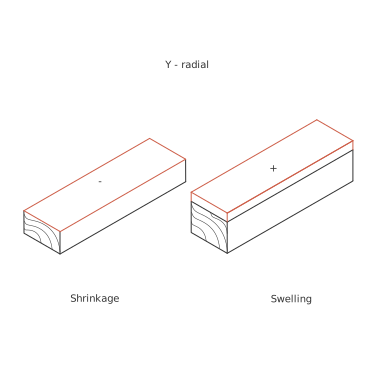
In these three directions, the wood changes shape differently in relation to the increase or decrease in water. The wood changes through shrinkage and swelling.
Since wood is hygroscopic, the cells can absorb and release water, causing the wood to swell or shrink (cf. Wagenführ, 2021, p. 23,24).
Carpenters and joiners have cultivated wood joints with relative dimensions for centuries.
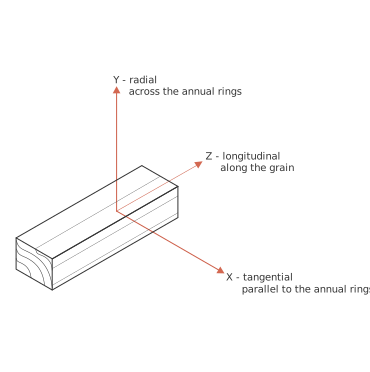
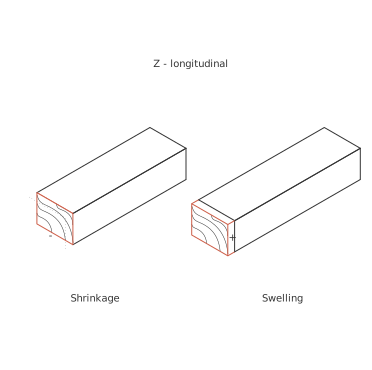
Longitudinal circa 0.4% change
Tangential approx. 10% change
Radial approx. 5% change
Illustrated by a wood joint